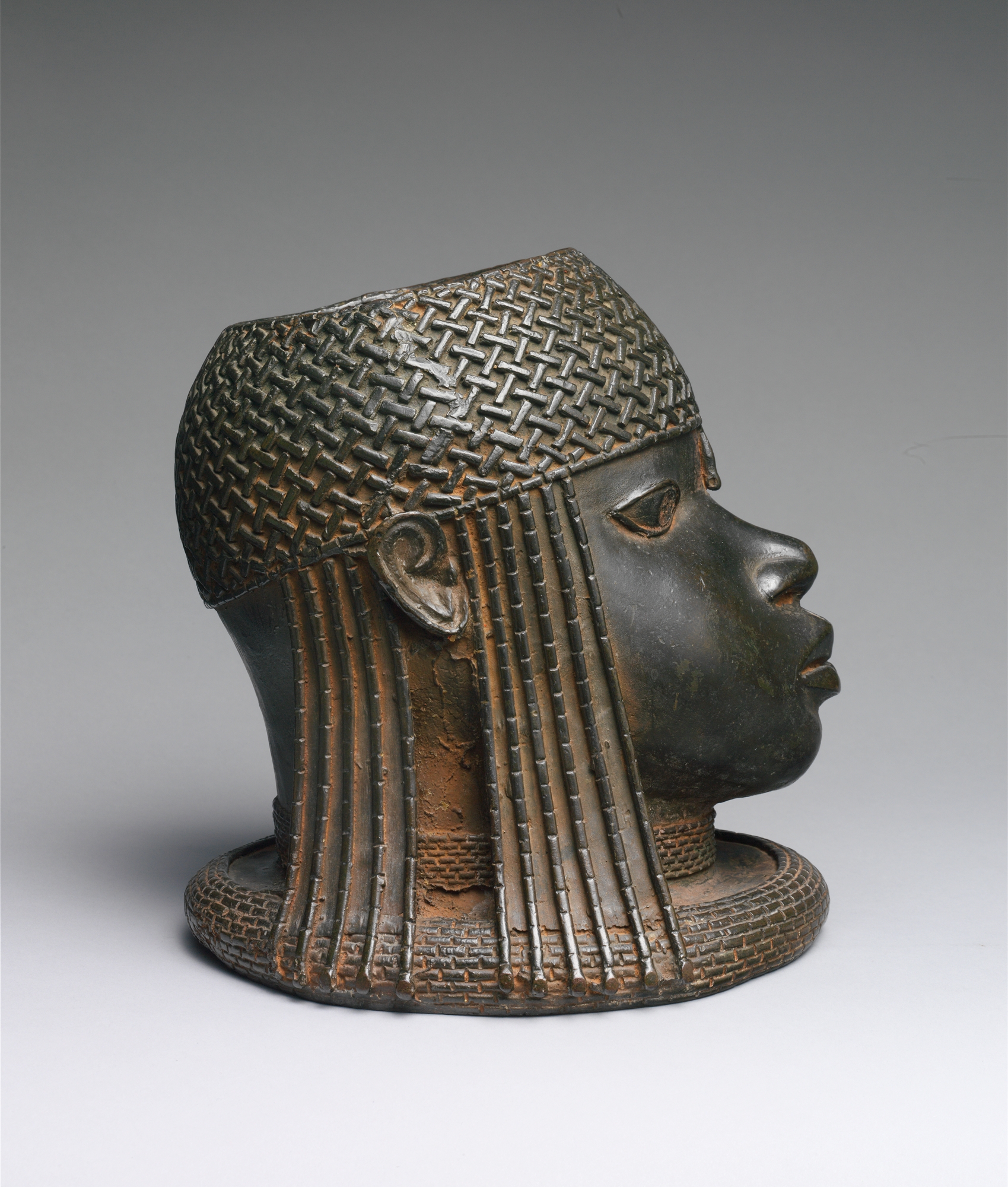
The Hero Artifact Series: Part 5 – The Benin Bronze Oba Head (Kingdom of Benin)
The Benin Bronze Oba head is the undisputed sovereign of the African art market. It is not merely a masterpiece of metallurgy; it is a profound historical document that has defined the global perception of African artistic sophistication for over a century.
1. Historical Context: The Divine Authority
In the ancient Kingdom of Benin (present-day southern Nigeria), the Oba (divine king) stood at the center of one of Africa’s most sophisticated courts. From the 16th century onward, master bronze casters in the royal guild created commemorative heads (uhunmwun-elao) using the lost-wax technique—among the most technically brilliant metal castings ever made anywhere in the world.
- The Royal Ancestor: These heads were placed on ancestral altars in the Oba’s palace to honor deceased kings. They portray the Oba in his full regalia: coral-beaded headdress and necklaces (symbols of power and wealth), scarification marks, and an idealized, serene expression conveying divine authority.
- The 1897 Expedition: The famous 1897 British Punitive Expedition looted thousands of these masterpieces (plaques, heads, figures, and ivories) from the royal palace. Today, they are recognized as pinnacles of African art—technically equal to anything produced in Renaissance Europe.
2. Highest Auction Results: The Investment Benchmark
Benin Bronze Oba heads are the undisputed kings of the African tribal art market. Their value is driven not just by rarity, but by their status as symbols of global art history.
- The Market Apex: A superb early 16th-century example (the “Ohly Head”) sold privately for £10 million (~$13.5 million USD) in 2016—marking a record for this class of object.
- Auction Performance: In 2007, Sotheby’s sold a magnificent Benin Oba head for $4.7 million. Exceptional pieces regularly achieve $500,000 – $2 million+ at marquee houses like Sotheby’s, Christie’s, and Bonhams when they appear. Even strong mid-tier examples command six figures. Demand remains extremely strong among elite collectors who view these as “Blue Chip” cultural assets.
3. Scholarly References: The Institutional Gold Standard
For the Benin Bronze, academic documentation is the primary metric of legitimacy.
- Institutional Benchmarks: The British Museum holds one of the world’s greatest collections of Benin Bronzes (over 900 pieces), including many iconic commemorative heads.
- Essential Reading: Key publications include foundational works by William Fagg and Philip Dark, as well as the essential catalogue Benin Art and Material Culture. These are the volumes auction houses and serious scholars rely on to authenticate and contextualize top-tier specimens.
4. YouTube Deep-Dive: Masters of the Craft
For a deep dive that covers both the technical brilliance of the bronze casters and the oral history encoded into these objects, this documentary is indispensable:
- What to watch for: This presentation provides a rare, close-up look at the “lost-wax” method [01:20] still used by modern artisans. It also offers essential context on how these artifacts served as “orally literate” documents for the kingdom [05:57], turning these sculptures into functional history rather than just “art for art’s sake.”
Featured Image: Head of an Oba, 16th–17th century. Courtesy of The Metropolitan Museum of Art.