The Hero Artifact Series: Part 4 – The Maya “Diving God” Ritual Vessel (Yucatán)
In the high-end Pre-Columbian market, the ceramic arts of the Postclassic Maya represent a pinnacle of narrative and theological complexity. The “Diving God” ritual vessel; a masterclass in ancient Maya iconography is more than a container; it is a portable portal bridging the mundane world and the divine forces of fertility, apiculture, and cosmic renewal.
Historical Context: The Mythology of Descent
This extraordinary lidded effigy vessel (typically standing 12.7–14 cm) originates from the Yucatán region—likely Quintana Roo, Mexico, or northern Belize. While most prominent during the Late Postclassic (1350–1521 CE), related prototypes emerged as early as 1000 CE.
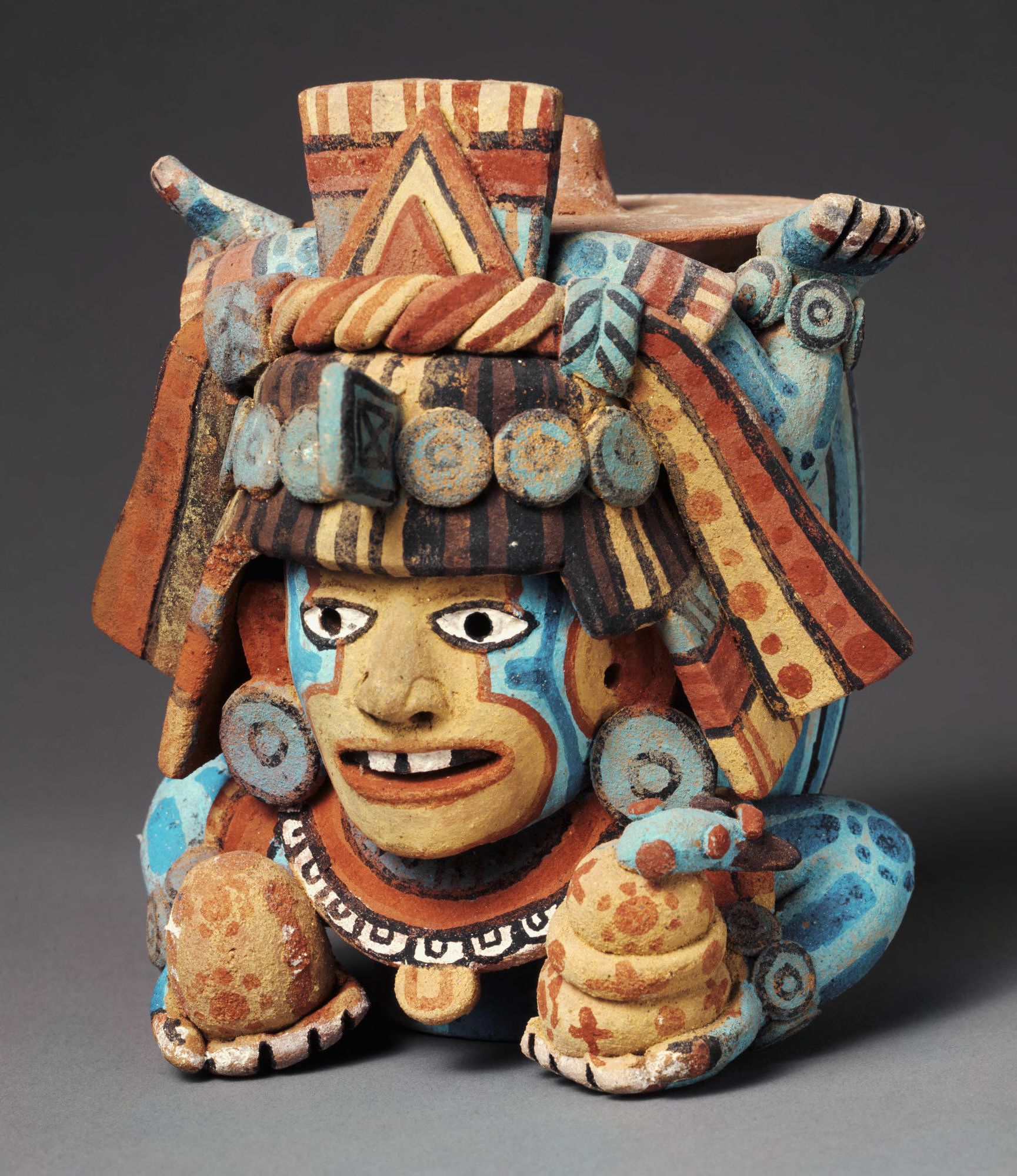
The vessel depicts the Diving God (or Descending God) in his iconic headfirst plunge. Though interpretations vary, scholars frequently identify him as a late-period variant of the Maya Maize God, often linked to Yum Kaax or Bolon Mayel. Key iconographic markers include:
-
- The Avian Headdress: Frequently an owl, symbolizing the messenger between worlds.
-
- Ritual Offerings: The figure often grasps cakes of copal incense or tamales.
-
- The Bee Connection: Heavily associated with Ah-Muzen-Cab (the God of Bees). As honey was a vital Maya trade commodity and ritual intoxicant, these vessels were essential to Yucatán’s “liquid gold” economy.
Rooted in the Popol Vuh and broader creation narratives, the “Dive” represents a descent into the underworld to retrieve the seeds of life bringing maize, cacao, and rain back to humanity.
Aesthetic & Craftsmanship: The “International Style”
These vessels are celebrated for their vibrant, post-firing polychromy. Utilizing a palette of brilliant reds, blacks, yellows, and the legendary, mineral-stable Maya Blue, they achieve a chromatic intensity rare in Pre-Columbian ceramics.
Technically, the style reflects the Mixteca-Puebla “International Style.” This aesthetic movement synthesized Classic Maya traditions with Highland Mexican influences, resulting in a sophisticated, pan-Mesoamerican visual language. The pedestal base and intricate lidded form mark these as high-status commissions, intended for the inner sanctums of the Maya elite.
Market Performance: The Investment Standard
The market for verified Maya ritual containers is extremely selective. Because the majority of extant examples are held in permanent institutional collections, the appearance of a “Diving God” vessel at auction is a significant event for “blue-chip” collectors.
-
- Market Benchmark: A notable Mayapan Diving God ritual container carried an estimate of €30,000–50,000 at Sotheby’s Arts d’Afrique, d’Océanie et des Amériques (December 2024).
-
- Category Performance: Comparable Late Classic and Postclassic polychrome narrative vessels routinely achieve $20,000–$100,000+ at Sotheby’s and Bonhams. Standout deity effigies with impeccable provenance continue to show strong year-over-year appreciation.
Scholarly References: The Institutional Gold Standard
Provenance and academic citation are the bedrock of value in this category. Collectors look to the following benchmarks for authentication:
-
- Institutional Holdings: Premier examples reside in the Princeton University Art Museum, the Jay I. Kislak Collection, and the British Museum (home to the famed Fenton Vase).
- Essential Literature: Key documentation includes The Maya Vase Book series (Kerr), and major exhibition catalogues such as Trésors du Nouveau Monde and Mexique, terre des dieux.
Visual Deep-Dive: Gods: Divinity in Maya Art Virtual Opening” from The Metropolitan Museum of Art.
This presentation provides a “gallery standard” framework for understanding these artifacts, specifically highlighting how the Maya visualized divine power through ceramic forms. The curators discuss the significance of the Maize God as a paradigm of regeneration and wealth often depicted “dripping with luxury” and associated with precious materials like jade and cacao. Viewing these ritual vessels through the lens of the Met’s exhibition helps contextualize the “Diving God” not just as a figure, but as a central player in a complex cosmic struggle for abundance and light.
Featured Image: Lidded effigy vessel in the form of a diving maize god, Late Postclassic, 1350–1521 CE. Courtesy of the Princeton University Art Museum