Specifications
- Origin: Tsonga / Venda Peoples, Limpopo/South Africa Region
- Period: 19th-20th Century
- Measurement: 78 cm
- Provenance: Documented UK Market
Context
The 19th-century material record of the Limpopo River basin and Southeast African coast bears witness to a vibrant, interconnected system of prestige trade, political tribute, and common metallurgical traditions. Because of the overlapping geographic boundaries and complex historical interactions between the Tsonga, Venda, Shona, and Zulu kingdoms, their martial and ceremonial regalia frequently share closely related stylistic typologies.
In his seminal study on Southeast African weaponry, scholar Tim Maggs explicitly notes that the classic half-moon or winged battle axe (isiZenze) found within the Zulu royal court was rarely manufactured by Zulu smiths themselves (Maggs, p. 186). Instead, the Zulu elite relied heavily on superior iron-smelting guilds to the north. Tsonga and Venda specialists were the master metallurgists of the region, forging highly prized prestige weapons that flowed southward through trade routes to become ultimate symbols of authority among Zulu izinduna (chiefs) and royals.
A primary diagnostic marker used to identify authentic 19th-century Tsonga craftsmanship is the deliberate, localized darkening beautification technique applied to the wood. Similar to the scorched, hyper-contrasted geometric ornament found on classic Tsonga prestige spoons and headrests, the wooden hafts of their axes feature a deep, masterfully fire-blackened patination intentionally concentrated at the terminal ends to highlight the sculptural form and contrast beautifully with the honey-toned grain of the central shaft.
Axe Description
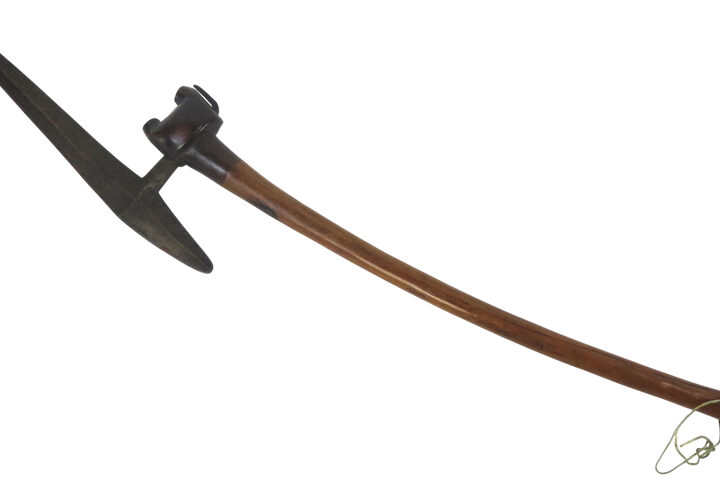
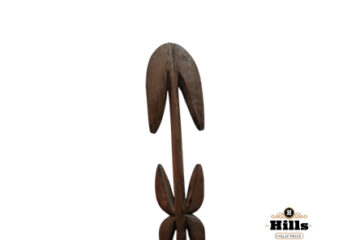
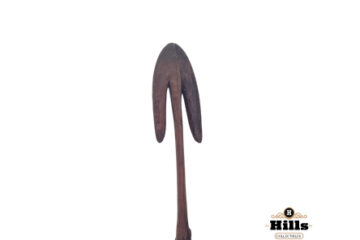
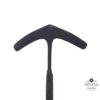
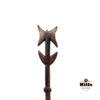
- The Blade & Tang: The weapon features a magnificent, hand-forged iron blade of classic dual-winged, crescent form. The blade face displays a prominent, raised architectural central spine that tapers elegantly to the upper and lower tips, providing maximum structural rigidity. The forged iron block transitions seamlessly into a robust perpendicular tang that completely pierces the wooden head. The tip of the tang protrudes cleanly through the reverse side of the finial and is neatly bent flush against the wood, serving as a secure mechanical anchor.
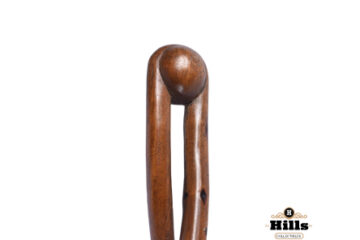
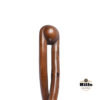
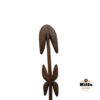
- The Finial / Head: The upper terminal of the haft is carved into a sculptural, bulbous head featuring the highly desirable dual-lobed “saddled” or “eared” configuration characteristic of elite Tsonga-Venda work. This structural swelling absorbs the impact of the heavy blade while doubling as an elegant aesthetic statement.
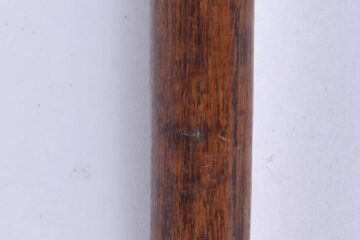
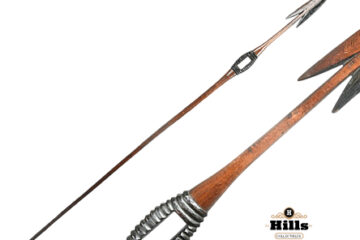
- The Haft / Shaft: Measuring an impressive 78cm, the wooden shaft features a graceful, ergonomic sweep. The wood transitions from a rich, naturally aged honey hue along the grip to a dense, dark chocolate fire-blackened finish at both the upper head and the lower terminal.
- The Pommel: The shaft concludes in a subtle, flared pommel cleanly pierced through with an original aperture, historically used to thread a hide or woven fiber carrying lanyard.
Rarity & Comparative Collections
Authentic 19th-century Tsonga and Venda weapons of this caliber are exceedingly rare on the private market. The vast majority of documented field-collected examples from this classic era were absorbed into institutional holdings by the early 20th century, leaving only a handful of premier specimens in private hands.
This specific axe aligns perfectly with elite institutional examples housed in the world’s leading ethnographic repositories:
- The British Museum (London): For close material comparisons regarding the perpendicular tang architecture and flared hafting styles of Southeast African prestige weaponry, see accession numbers Af1983,11.140 and Af1954,23.2815.
- The Metropolitan Museum of Art (New York): The structural tension of the crescent blade, the raised central spine, and the prestige status of related Southeast African axes are mirrored in the Met’s permanent collections, specifically accession numbers 635754 and 635755.
- The Museum of Anthropology (University of Missouri): Institutional research into regional variations of African prestige axes confirms the status of the curved haft and eared finial as a marker of high-status leadership insignia rather than utilitarian combat gear.
- North Carolina Museum of Art: A beautiful ceremonial Tsonga Axe, OBJECT NUMBER 2014.8
References
- Maggs, T. The Zulu Battle Axe. (Page 186 context on external trade and regional variants).
- The British Museum, London. (Accession items: Af1983,11.140 / Af1954,23.2815).
- The Metropolitan Museum of Art, New York. (Collection numbers: 635754 / 635755).
- University of Missouri Museum of Anthropology, African Axes Exhibit.
- North Carolina Museum of Art: (Collection Number 2014.8).