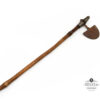
A Rare Zulu Prestige Battle Axe (isiZenze)
Description
- Type: Zulu isiZenze (Crescent-Bladed Status Battle Axe)
- Period: Late 19th Century
- Provenance: United Kingdom market; private collection
- Materials: Forged steel blade with decorative lobe-shaped tang, dark stained hardwood haft, fine woven wirework bindings, iron suspension loop
- Measurements (Approximate): Overall Length: approx. 80–85 cm, Blade Span: approx. 22–26 cm
Rare Zulu Chief’s Crescent-Bladed Prestige Axe (isiZenze)
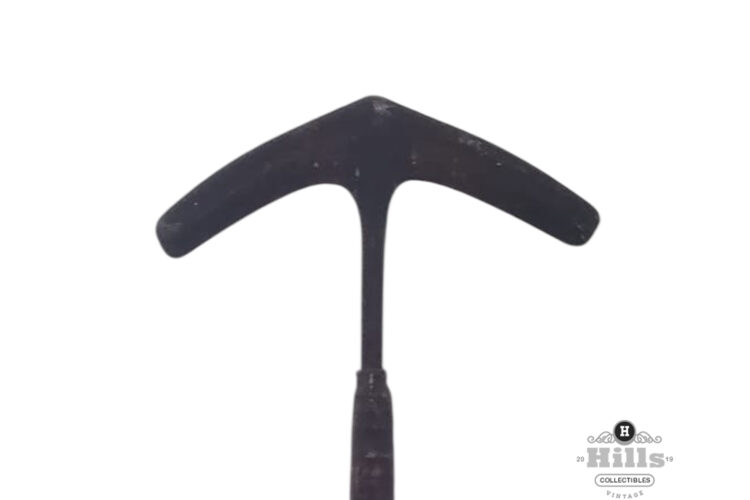
This exceptional isiZenze represents a superior class of Zulu status weaponry. Characterized by its gracefully curved upper head and distinctive lobed blade collar, this axe was designed primarily as an emblem of high office, authority, and lineage for Zulu chiefs (amakosi) and senior military commanders (indunas).
Physical Attributes & Workmanship
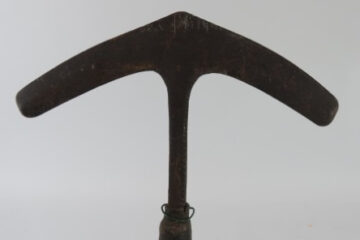
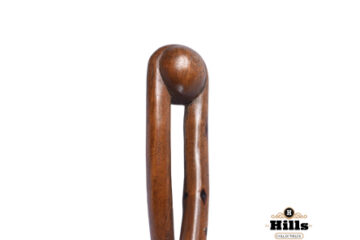
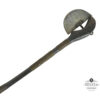
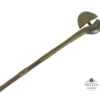
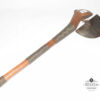
- Lobed Blade & Mount: Features a classic semi-lunar hand-forged steel blade with an ornamental lobed (clover-shaped) shoulder at the tang interface. The top point of the crescent secures into the heavy hook-curved wooden head, creating a strong structural and aesthetic arch.
- Dark Hardwood Haft & Hardware: Carved from indigenous South African hardwood, treated to a rich, dark ebony-like patina. An iron suspension loop is anchored through the crown of the head.
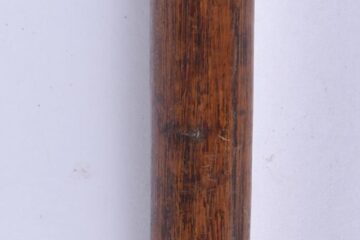
- Woven Wirework: Wrapped in multiple sections of intricate, finely aged woven wire binding along the grip and upper section. The base terminates in a solid butt-end pierced with a lanyard hole.
Cultural & Historical Context
While standard battle axes featured simpler tang fittings, axes incorporating elaborate lobed tangs and iron suspension loops signified high wealth and prestige. The curved head design allows the axe to be comfortably rested over the shoulder during ceremonial gatherings and courtly assemblies.
Reference:
- Kennedy, C. (1991). Art and Artifacts of Sub-Saharan Africa.
- Maggs, T. (1992). The Zulu battle-axe: Its origins and significance. Annals of the Natal Museum, 33(2), 175–187.