

Description
- Time Period: 19th Century
- Origin: South Africa
- Materials: Nguni cow horn
- Provenance: Germany, Provenance Documented: Certificate of Authenticity (COA) 19th Century Guarantee. Customs Declarations in accordance with the Cultural Property Protection Act.
Description
African tribal art is among the most intellectually engaging and historically resonant artistic traditions in the world. Since the early 2000s, African art has experienced unprecedented global recognition among scholars, collectors, museums, and major auction houses in Europe and the United States. Within this expanding field, certain rare objects stand apart for their cultural, historical, and artistic significance.
Among the most exceptional of these are the 19th century engraved Nguni cattle horns from South Africa, attributed to Zulu artists. These horns are not merely utilitarian objects, but sophisticated visual documents—rare narrative artworks that record encounters between British colonial forces and Zulu regiments during the Anglo-Zulu War of 1879, including events surrounding the Battle of Isandlwana.
Horn engraving was a highly skilled artistic practice in southern Africa, traditionally associated with snuff containers and gunpowder horns. However, engraved narrative cattle horns of this type were produced in extremely limited numbers and remained largely unknown outside museum collections until scholarly publications brought them to wider attention in the late 20th century.
Historical Context & Scholarship
The earliest known examples entered the Natal Museum (Pietermaritzburg), where only a small group of engraved horns was preserved. Their importance was first recognized in academic literature with Tim Maggs’ seminal 1990 paper, “A Glimpse of Colonial Life through Zulu Eyes”, which introduced these horns as visual narratives created from an African perspective. Further scholarship by Dr. Patricia Davison expanded understanding of their artistic unity, historical content, and cultural value.
Subsequent research identified comparable examples in major institutions including the British Museum and the Smithsonian Institution, with stylistic analysis indicating that most were engraved by the same unknown master artist—making each surviving horn a rare and significant work.
A small number of these horns entered private collections after being auctioned at the Colonial and Indian Exhibition, London, 1886, where they were regarded as objects of curiosity and rarity. Today, the majority remain in museum holdings, with very few available to private collectors.
Engraving & Artistic Features
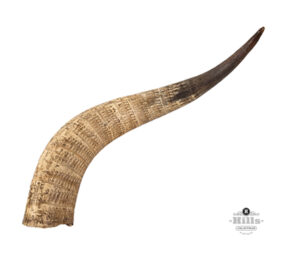
This horn displays a richly detailed engraved surface, carefully prepared by smooth scraping to create an even background. The imagery is executed with exceptionally fine incised lines, blackened using a traditional mixture of soot and fat to enhance contrast and legibility.
Notable features include:
- Finely incised narrative scenes depicting British soldiers and Zulu warriors
- British infantry shown marching, standing, mounted on horseback, and engaged in combat
- Soldiers depicted wearing Glengarry caps and carrying rifles
- Horsemen, military bands, and musical instruments rendered with remarkable precision
- A consistent military theme forming a continuous visual narrative around the horn
The engravings function as a Zulu visual interpretation of colonial encounters, offering a rare indigenous perspective on 19th century historical events.
Significance
This engraved cattle horn is both an artistic masterpiece and a historical document. It stands at the intersection of African art, colonial history, and ethnographic scholarship. Objects of this caliber are increasingly sought after by major museums and serious collectors of African, British colonial, and military history.
References
- Davison, P. (2016). Visual narratives of the Anglo-Zulu War: Cattle horns engraved by an unknown African artist.
- Davison, P. (1976). Some Nguni crafts: the uses of horn, bone and ivory. Annals of the South African Museum.
- Maggs, T. (1990). A glimpse of colonial life through Zulu eyes: 19th century engraved cattle horns from Natal. Natal Museum Journal of the Humanities.