The most common definition of the term „Oceania“ describes the three areas Melanesia (from the Greek mela (s) for „black“ and nēsoi for „islands“), Micronesia (from the Greek mikros for „small“ and nēsoi for „islands“) and Polynesia (from the Greek polýs for „many“ and nēsoi for „islands“).
The English name Oceania encompasses the region of French Océanie, Dutch Oceanië, German Ozeanien, Spanish Oceanía and Portuguese Oceânia.
These areas, somewhat different in their extent, sometimes with Borneo, sometimes without, sometimes with a part of the Philippines, sometimes without, etc., were named by the namesake countries Portugal, France, Spain, Great Britain, the USA, the German Empire and the Netherlands from their own point of view set as a colonial power. Today, most of the islands in this region in the Pacific (North and South) and Indian Oceans, the Banda Sea, the Philippine, Chinese and Coral Seas are largely independent or still considered to be the property of a „foreign“ state.
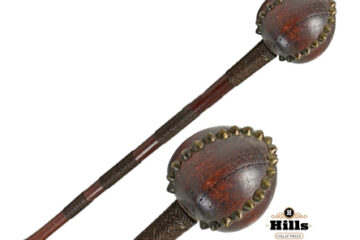
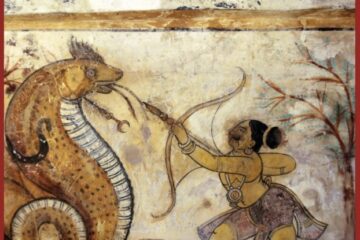
This book describes the arrows, bows, quivers, pellet bows, blowpipes, spears and throwing sticks of Oceania based on historical works and various private and museum collections.
Volume 1: 436 pages with more than 500 mostly colour photographs, more than 230 illustrations, 11 cards, 45 plates, a register of the most important search terms, as well as a detailed literature register.
Volume 2: 316 pages with more than 400 mostly colour photographs, more than 200 illustrations, cards and plates. This supplement to the first volume of „Bows, Arrows, Blowpipes and Spears of Oceania“ became necessary for several reasons. On the one hand, a version extended with the content developed here would overwhelm or overcharge most readers with its enormous wealth, on the other hand it turned out that the length of this supplement to the book has assumed a length that exceeds 720 pages all together. A one-volume, expanded edition would make the already weighty book too heavy and voluminous. Nevertheless, the contents of this supplementary volume seem to me to be too important and informative for the interested collector and lover of the topic to do without it entirely. Particular attention should be paid to the excerpts on the subject from Biró‘s two books on Berlinhafen and Astrolabe Bay and those by Felix Speiser, Le Roux and Nevermann. All of them are important sources in this field.
In the present supplement, the page numbers are provided consecutively to the first book starting with 419, so that the page numbers in the registers are not confusing. The registers with the additions are attached and thus apply to the entire work. Further maps are also attached to this supplementary volume.