The Hero Artifact Series: The Polynesian U’U War Club – Marquesas Islands
As we move from the prestige arts of Africa to the vast reaches of Oceania, the Marquesan U’u stands as the undisputed “Hero Artifact.” In the 2026 market, it remains an icon of sculptural minimalism and a cornerstone of “Blue Chip” tribal art collections.
In the volcanic heart of French Polynesia’s Marquesas Islands, the u’u (pronounced “oo-oo”) was far more than a weapon; it was the ultimate symbol of a warrior’s mana, status, and divine protection.
Historical Context: The Pantheon in Hand
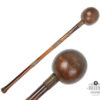
Carved from ultra-dense ironwood (Casuarina equisetifolia, called toa—the same word used for “warrior”), these massive bifacial clubs (often 1.2–1.5 meters long) were designed for both lethal close-combat and as ceremonial staffs of authority.
- The Guardian Tiki: The head of the club features mesmerizing, multi-faced tiki heads that stare in every direction. These faces represent the atua (gods) in watchful guardian mode, ready to shield the bearer.
- The Alchemy of Patina: Each u’u is unique, hand-carved with shark-tooth tools. The deep, glossy obsidian patina was achieved through a ritualized process: burial in the mud of taro swamps followed by tireless polishing with scented coconut oil.
- The First Contact Record: European explorers first documented these “stately emblems” during Captain Cook’s voyages in the 1770s. By the mid-19th century, hundreds had entered museum collections, but today only about 200 authentic classical-period examples survive in private and public hands.
Expert Insight: Anthony Meyer on the U’u
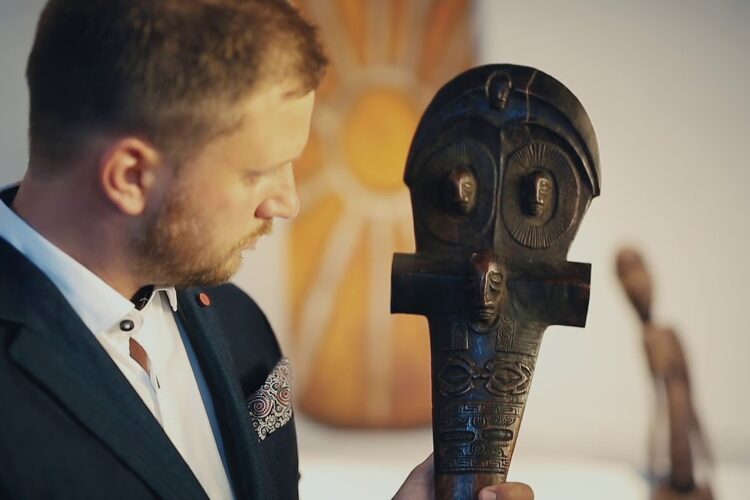
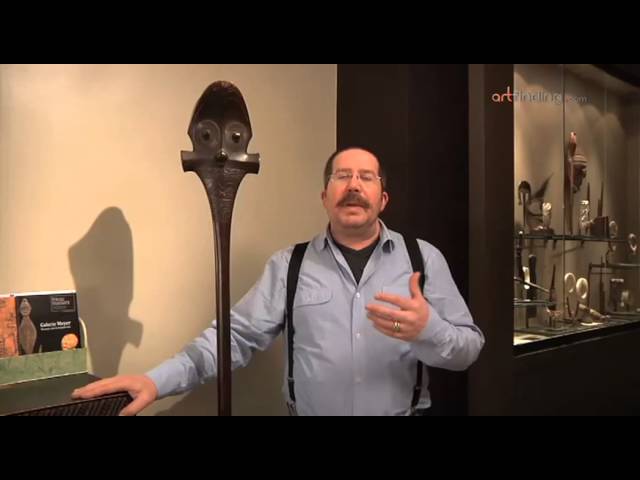
In this classic review, renowned Oceanic art expert Anthony Meyer examines a remarkably large (153 cm) example, illustrating the “face-within-a-face” motif where the eyes and nose of the primary head are composed of smaller tiki figures.
- Key Takeaway: Meyer highlights the transition of the u’u from a practical weapon to a “priestly emblem,” where one literally “goes to war carrying one’s pantheon”.
Highest Auction Results & Market Outlook (2026)
The u’u is a frequent top-lot at Sotheby’s marquee sales. Its appeal lies in its “modernist” silhouette, often drawing comparisons to 20th-century masters like Giacometti or Brancusi.
- The Benchmark: Exceptional examples with early provenance (e.g., the Hooper or Rubinstein collections) consistently command $1 million to $1.5 million USD.
- Current Trend: In 2026, collectors are prioritizing “untouched” surfaces. The market favors the dry, authentic “crusty” patina of 18th-century pieces over later, heavily waxed trade items.
Scholarly References: The Institutional Standard
For collectors looking to authenticate or compare motifs, the following resources are considered the “Gold Standard”:
- The British Museum: Houses some of the finest surviving u’u, notably specimens Oc1920,0317-1 and Oc1978,Q.838. These are beautifully documented with detailed provenance and serve as the diagnostic baseline for the high-classical style.
- Essential Reading: Carol S. Ivory’s seminal paper, “Marquesan ‘U’u: A Stylistic and Historical Review” (1994), is the definitive guide to dating and regional variations.
- Secondary Research: The Pitt Rivers Museum and the British Museum’s Pacific Art in Detail series echo the reverence for these as the most collected Marquesan art objects in the world.
Next in the Series: We journey to the Philippines to explore the Ifugao Bulul the rice deity guardian.