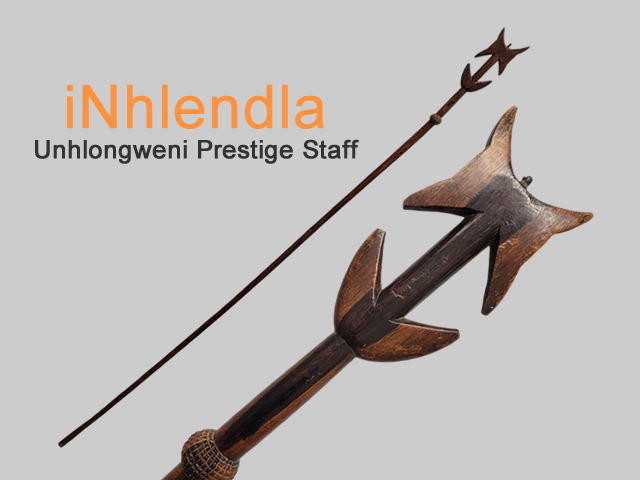
Inhlendla Series: The Unhlongweni Prestige Staff Variant
The Majestic Unhlongweni Prestige Staff: A Masterwork of Zulu Royalty
For centuries, the Inhlendla has stood as the ultimate signifier of Zulu Ubukhosi—the essence of chieftainship and royal authority. More than a mere staff, it is a localized embodiment of law, a conduit for ancestral power, and a badge of rank reserved for the King, high-ranking indunas, and those granted specific royal dispensation.
In our ongoing series, we have explored the two primary expressions of this form:
- The Royal Metal-Tipped Variant: The classic swallow-tail iron spear seen in the regalia of modern Zulu monarchs.
- The All-Wood Prestige Spear Staff: A lethal, spiritual “Royal Weapon” (cf. British Museum Af1936,1015.1).
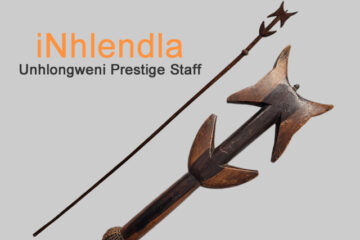
Today, we unveil the third and rarest variant: the Unhlongweni. Named for its commanding verticality and elongated profile, this 160 cm masterpiece is a monumental expression of Zulu wood-carving at its zenith.
A Synthesis of Zulu Iconography and Form
Carved from a single, dense piece of indigenous hardwood, this staff utilizes the natural “heart and soul” of the timber. The deep, chocolate-toned heartwood contrasts beautifully with lighter sapwood streaks, creating a shimmering effect that emphasizes its hand-carved contours.
The Visual Vocabulary of Power:
- The Winged Apex: The head features dramatic, sweeping “wings” with precision-carved barbs. These evoke the geometry of the Ihawu (war shield), suggesting that even in ceremony, the leader remains the protector of his people.
- The Horn Transition: Directly below the wings are bold, crescent motifs representing the Bull’s Horns. In Zulu cosmology, the bull is the “Great Ancestor”—a symbol of virility and the indomitable spirit of the nation.
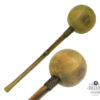
- The Amasumpa Node: Midway down the shaft sits a magnificent carved spherical section featuring the Amasumpa (wart-like) texture. This raised, lattice-patterned relief is a sacred tactile language in Zulu artistry, signifying high status and spiritual energy.
Auction Comparative & Institutional Parallels
To understand the rarity of this 160 cm Unhlongweni, one must look at the few surviving examples from the late 19th century:
The C&T Auction Parallel (2019): A striking parallel appeared in the prestigious Mick Woodfield Collection. It featured a high-ranking leader’s ihawu shield accompanied by its original 125 cm staff. That staff’s head was similarly symbolic, notably incorporating a battlefield trophy—a fragment of a British pocket watch—likely taken during the 1879 conflict.
While the Woodfield example is iconic for its trophy element, our 160 cm Unhlongweni stands as a purer, more imposing expression of the all-wood royal tradition. Its height and complexity place it in direct conversation with:
- The British Museum (Af1954,23.1329): A near-identical 169 cm double-barbed ceremonial staff, confirming the authenticity of this rare form within the 19th-century royal court.
A Relic of 19th Century South Africa
This Unhlongweni carries the weight of history. It originates from a respected UK dealer and collector of Zulu 19th century artifacts. Items of this caliber were typically recovered from the field or surrendered at the fall of Ulundi during Anglo-Zulu Wars of 1879, then treasured in private British collections for over a century.
A Western Parallel: The Roman Aquila (Legionary Eagle Standard)
To fully appreciate the profound cultural weight of the Inhlendla, consider its closest Western counterpart: the Roman aquila, the sacred eagle standard of the legions.
Just as the Inhlendla embodied Zulu royal authority, law, and ancestral power, the aquila was far more than a military banner — it was the living soul of the legion itself. Each Roman legion carried only one eagle, borne by a specially honoured officer called the aquilifer. The eagle represented Jupiter, the supreme god and “Father of the Roman state,” and symbolized divine favour, legionary honour, and the very identity of the unit.
Losing an aquila in battle was considered the ultimate disgrace — a stain that could end a legion’s existence. Roman generals went to extraordinary lengths to recover lost eagles (Augustus famously mourned the loss of three legions and their eagles in the Teutoburg Forest, reportedly banging his head against a wall and crying “Quintilius Varus, give me back my legions!”).
This sacred status is dramatically immortalised on the famous Augustus of Prima Porta statue. On the emperor’s breastplate, the central scene shows a Parthian king returning a captured Roman eagle standard to a Roman figure — celebrating Augustus’s greatest diplomatic triumph: the recovery (in 20 BC) of the legionary eagles lost decades earlier at the Battle of Carrhae. The entire sculpture uses this imagery to proclaim imperial victory, divine legitimacy, and restored Roman honour.
In exactly the same way, the Unhlongweni staffs served as rallying points for warriors, embodiments of leadership, and tangible links between the earthly ruler and higher powers.
The Inhlendla is, in every sense, the Zulu aquila; a prestige staff that commanded absolute loyalty and carried the spirit of the nation.