

Description
Time Period: Late 19th – Early 20th Century
Origin: Zulu Kingdom, South Africa
Materials: Two-tone hardwood (honey maple shaft, deep chestnut head), iron studs
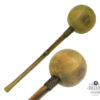
Length: ~26″ (66 cm) | Head ~4″ (10 cm) diameter
Code Name: “Mfecane II”; check out its cousins in our listings.
Provenance: UK Market, documented acquisition
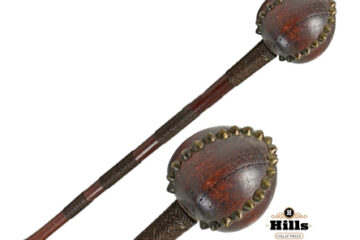
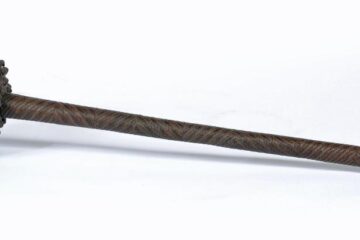
Executioner Knobkerrie – “Mfecane II”
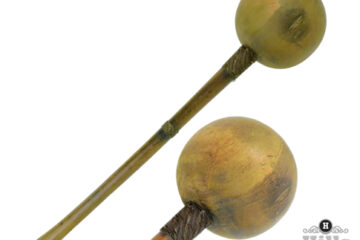
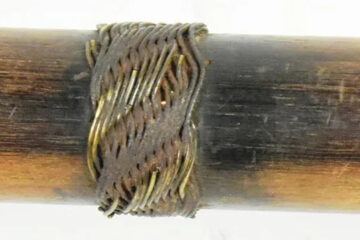
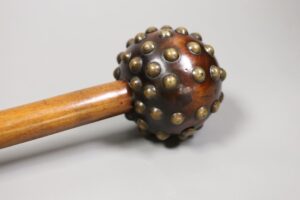
Shaft: Warm honey maple (rare light tone), octagonal grip flowing to a tapered butt
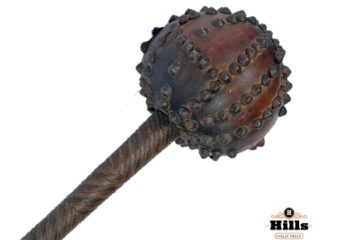
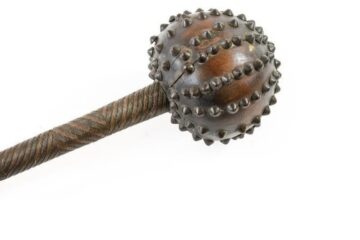
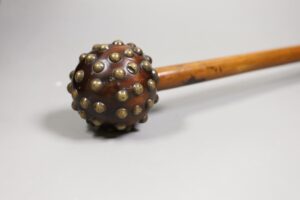
Head: Beautiful Deep blood-chestnut sphere, studded with hand-hammered iron studs, dark patina in-between
An exceptional and historically significant example of a Zulu iwisa (knobkerrie), specifically attributed to the role of an executioner. This piece features a perfectly spherical head of dense indigenous hardwood, intricately inlaid with a high density of brass studs (isikhonkwane).
The use of brass—a luxury material often reserved for the Zulu elite and those of high status—contrasts sharply with the intended function of the object. This rare artifact embodies the subtle juxtaposition of death and beauty, representing both the absolute authority of the Zulu state and the refined aesthetic of 19th-century Southern African craftsmanship.
The shaft shows a deep, honey-colored patina from decades of handling, while the head has aged to a dark, rich ebony tone. The brass studs are individually hand-set, creating a textured, formidable striking surface that remains remarkably intact.
Historical Note:
“The executioner’s iwisa was never cleaned – the stains proved loyalty to the king.”
Condition Report:
Studs 100 % original, no repairs, tight studs, scratches, dents commensurate to age
Wood sound – light surface scratches
honey glow + chestnut depth
Ideal Acquisition For
The Discerning Collector: An essential centerpiece for private connoisseurs of African tribal weaponry and ethnography who prioritize provenance and material rarity.
Institutional Curatorship: A premier candidate for museums, universities, or cultural institutions looking to anchor exhibitions on pre-colonial Southern African history, the mechanics of the Zulu State, or the evolution of tribal material culture.
Legacy Collections: This knobkerrie is a museum-quality specimen, offering the rare opportunity to possess an object that commands both visual attention and historical gravity.