- Origin : KwaZulu-Natal, South Africa
- Date : Late 19th / Early 20th Century
- Materials : Indigenous Hardwood
- Dimensions : ~63cm long
Provenance: The significance of this piece is heightened by its distinguished provenance, tracing through two of the most respected names in the field of African and Tribal Art:
- The Seymour Lazar Collection (Palm Springs): A legendary collector known for his discerning eye for form, surface, and rarity. His collection was renowned for pieces that showcased the “essence” of a culture’s aesthetic.
- The Norman Hurst Collection (Cambridge, MA): A prominent dealer and scholar whose expertise in African material culture ensured that only pieces of high ethnographic integrity and historical importance were acquired.
- Auction History: featured at Bonhams Fine Art Auctioneers & Valuers
Condition Report: The piece is in excellent ethnographic condition, presenting in an “as-found” state with no modern restorations.
- Integrity: The hardwood remains structurally sound with no significant chips to the delicate lobe rims.
- Surface: A naturally occurring age-crack (shrinkage) is visible on the underside of the head, a common and desirable indicator of authentic 19th-century hardwood seasoning.
- Wear: The cavities show a rich, darkened “caked” patina from historical snuff residue, adding to the piece’s authenticity and provenance.
Overview
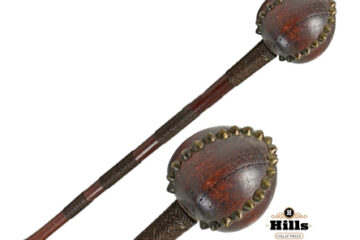
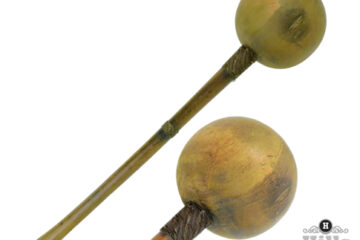
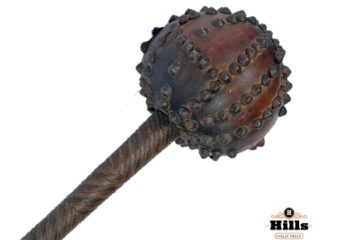
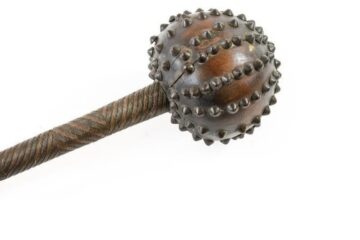
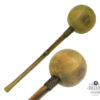
A masterful example of Zulu sculptural utility, this iwisa (knobkerrie) transcends the typical form through its highly unusual, multi-chambered head. Carved from a single block of dense, honey maple-hued hardwood, the piece balances the aggressive weight of a traditional club with the delicate, rhythmic precision of a ceremonial snuff vessel.
The “Rosette” Head & Cavities
The head is a feat of symmetrical carving, articulated into a seven-lobed, floral silhouette. Each individual lobe is crowned with a shallow, circular cavity, creating a striking “rosette” formation. Unlike the standard single-well snuffkerrie, this heptagon configuration suggests a specialized purpose; perhaps for the presentation of distinct snuff blends or for communal ritual use. The interior of each well exhibits a soft, buttery smoothing, evidence of decades of use and the repeated extraction of fine powdered tobacco.
Patina
The wood possesses a profound, light-absorbing patina, ranging from deep espresso to warm russet undertones. The surface is not artificially glossed but rather “spirit-polished” through generations of handling. Subtle highlights appear on the high points of the lobes, where the natural oils of the hand have buffed the grain to a soft luster.
Architectural Construction
A distinct longitudinal line traverses the head and merges into the shaft; this is not a crack, but a masterful “witness mark” of the traditional carving process, reflecting the artisan’s navigation of the heartwood to ensure structural integrity across the multiple hollowed chambers.
The Shaft
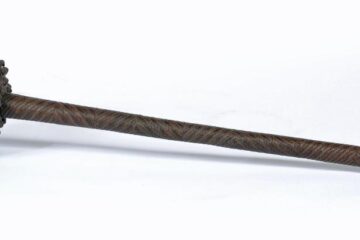
The shaft is purposefully robust, tapering slightly toward the base. It remains unadorned to maintain focus on the complex geometry of the head. Its thickness at the neck ensures a seamless transition of weight, providing the balanced, forward-heavy “heft” characteristic of high-status Zulu weaponry.
Curatorial Note
The rarity of the six-chambered head cannot be overstated. While most snuff-sticks prioritize volume, this example prioritizes aesthetic symmetry and ritual complexity. It is a sophisticated hybrid: a functional tool of prestige and a delicate work of South African geometric abstraction.