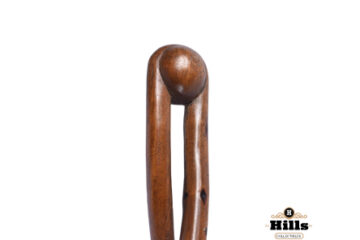
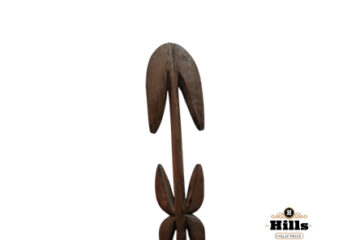
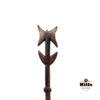
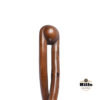
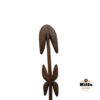
- Quantity: 54 miniature stool set
- Material: Sese (Holarrhena floribunda) and bodaa wood.
- Dimensions: Approximately 6.5–9 cm in width; heights vary by design (typically 6–7 cm).
- Provenance: Documented UK Market; typologically matches the 1979 Christie’s auction sets.
- Condition: Delicate but intact; age-appropriate micro-cracks & chips (identical to museum examples)
Ashanti Region, Ghana | Circa 1940s Directly Corresponding to the Christie’s 1979 / British Museum Reference Collection (Af1979,16.1-75)
The “Pattern Book” of Kings
This remarkable collection of 54 miniature stools functions as a three-dimensional “pattern book” for Akan royalty. Crafted by master carvers in the heart of the Asante kingdom during the mid-20th century, these precise 1:12 scale models served as a catalog for kings, chiefs, and queen mothers to select designs for their full-sized state stools. Each piece encapsulates the essence of Asante artistry, symbolism, and cultural heritage, making this set an unparalleled resource for collectors and scholars alike.
Institutional Correlation and Rarity
This assemblage belongs to the elite corpus of “Christie’s Typologies,” a rare group of reference collections from the 1979 Christie’s auction in London. The British Museum acquired a comparable set of 72 miniature Akan (Asante) stools in Lot 267 of that sale (now cataloged as Af1979,16.1-75), with one piece dated 1943—aligning perfectly with the circa 1940s origin of this collection. Both sets feature distinctive pencil/pen inscriptions on the undersides, recording the Twi names of the stool designs. This shared feature provides an invaluable ethnographic and linguistic archive, enabling direct comparisons with the British Museum’s holdings and elevating this collection to museum-quality status.
Scholarly Analysis and Taxonomy
Hand-carved from single blocks of sese wood (Holarrhena floribunda) or bodaa wood, each stool adheres to the classic Akan tripartite structure:
- Base: Symbolizing the earth and stability.
- Pedestal: Conveying the stool’s symbolic message through intricate carvings.
- Seat: Representing the soul or essence of the owner.
The designs draw from Akan cosmology, history, and proverbs, offering a comprehensive survey of Asante sculptural forms. Highlighted typologies include:
- Kotoko Dwa (Porcupine Stool): Embodying the Asante motto, “If you kill a thousand, a thousand more will come,” symbolizing resilience and multiplicity (cf. British Museum Af1979,16.12).
- Sakyi Dwa: Distinguished by bold geometric openwork supports, traditionally linked to the executioner’s stool, evoking authority and justice.
- Me Fa Hyia Me Dwa: The “encircling” motif, signifying unity and the cohesive power of the state under the Golden Stool.
- Mmaremu Dwa: Featuring a cross design, representing the four cardinal directions and the expansive reach of the Akan empire.
These examples illustrate the diversity of Akan semiotics, where each pedestal’s motif encodes philosophical, historical, or social wisdom.
Inscriptionary Evidence
A hallmark of authenticity, the undersides of these stools bear handwritten pencil or incised Twi titles—mirroring those in the British Museum collection. For instance, just as BM Af1979,16.22 is inscribed “Kumawu Stool,” pieces in this set include analogous primary documentation. This feature allows for precise cross-referencing with institutional databases, transforming the collection from mere artifacts into a vital scholarly tool for studying Akan nomenclature and iconography.
Condition and Curatorial Notes
- Surface: Retains the original matte adze-finish with visible knife marks, free from modern stains or treatments.
- Patina: Exhibits a fine, dry-wood patina indicative of mid-20th-century storage in temperate European climates (likely UK private collections).
- Integrity: The set is fully intact, with only minor stress checks from natural wood shrinkage consistent with the condition of the 1979 British Museum acquisitions.
Overall, the pieces are in excellent vintage condition, preserving their historical integrity.
Perspective
Individual Akan stools abound in the market, but a complete typology set like this; comprising 54 meticulously crafted models is a rarity worthy of museum acquisition. It embodies the “DNA” of Asante statecraft, offering collectors a panoramic view of African geometric sculpture and scholars a primary source on Akan symbolism. In an era of increasing appreciation for African art, this collection stands as a testament to the ingenuity and cultural depth of the Asante people.
Comparable Sales
- Christie’s London, 25 July 1979, Lot 267: 72 miniature Akan stools (acquired by the British Museum as Af1979,16).
For inquiries, high-resolution images, or further documentation, contact us. This is a once-in-a-generation opportunity to own a piece of living African history. Enquire about this at HillsCollectibles.com